A smart hydroponic farm on a recycled PC: field notes from UTM with AeroGreen Asia
Before any sensor or AI went in, we took a hydroponic farm at UTM apart and washed it. Field notes from the AeroGreen Asia project: how sensors, an ESP32 and relays will run it, why an old i7 PC with no GPU is enough for its AI model, and what 28 grow lights draw.
- Project
- IoT smart hydroponics at Universiti Teknologi Malaysia (UTM)
- Company
- AeroGreen Asia (艾科绿). Boss: Teo Choon Yee. Also at the briefing: Eric
- Team
- Ma Liwei, Tan Bing Yan, Mohammed Ali Kareem Al-deen and Sean Seah, with Teo Choon Yee, as named in AeroGreen Asia’s post
- Briefing
- Thursday 15 October 2026, 7:30–9:00 pm, in person at Tea Garden, Sutera Utama
- Site day
- Sunday 25 October 2026, 10:00 am–4:00 pm, at UTM
- Status
- In progress. Next: configuration at the UTM campus laboratory
AeroGreen Asia is turning a conventional hydroponic system at Universiti Teknologi Malaysia (UTM) into a smart one, with help from an intern team that includes me. This post covers the first two steps: the project briefing on 15 October 2026, where I chose this project, and the site day on 25 October, when we took the system apart, cleaned it and put it back together.
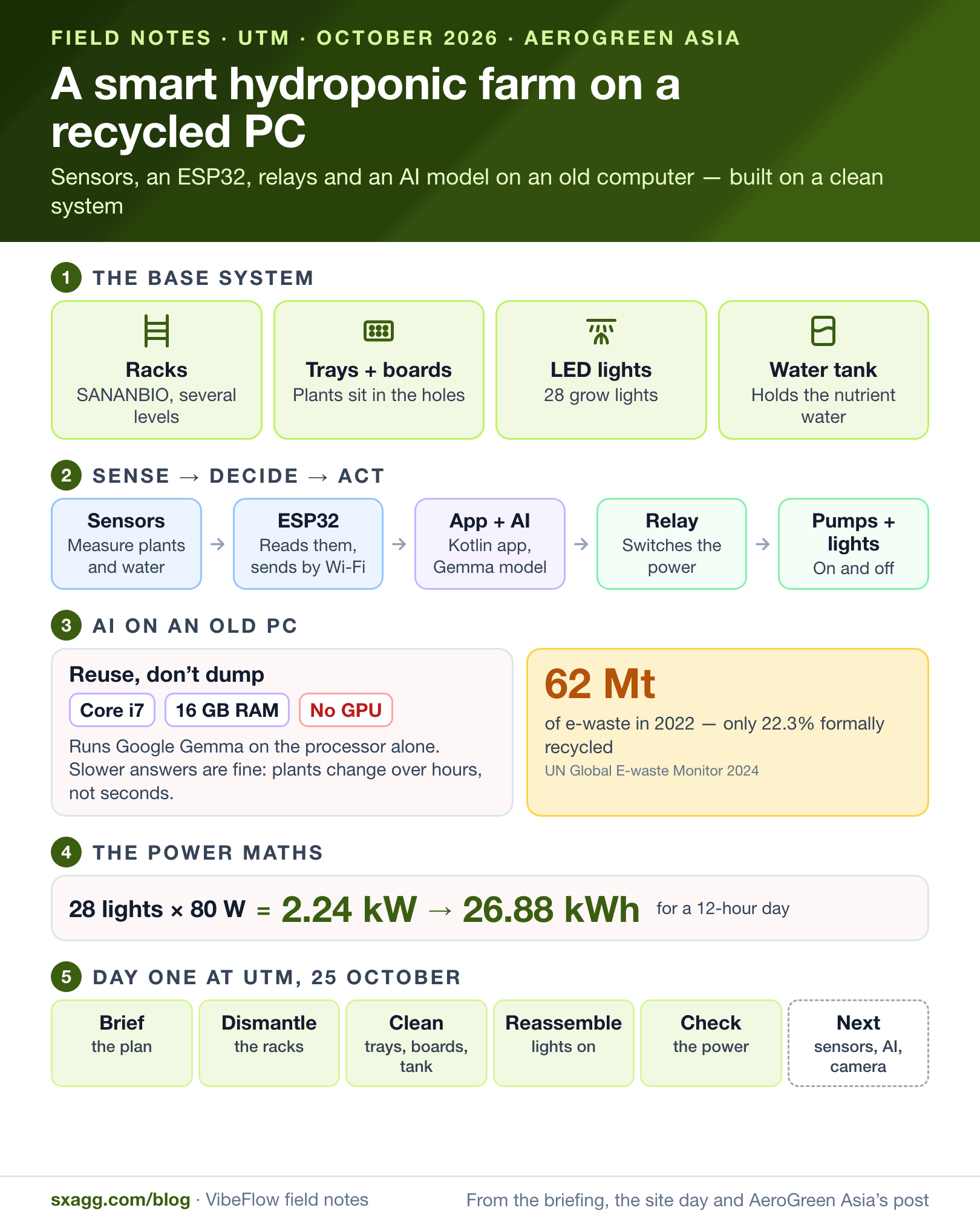
The infographic sums up the project on one page. The sections after it explain each part, with photos from the day.
Terms used in this part
- Hydroponics
- Growing plants without soil. The roots take water and nutrients from a nutrient solution instead.
- Precision farming
- Farming by measurement: sensors and data decide when to water, feed or light the plants, instead of a fixed routine or a guess.
- ESP32
- A small, cheap microcontroller board from Espressif with built-in Wi-Fi and Bluetooth, popular for reading sensors in IoT projects.
- Relay
- An electrical switch that a small signal, for example from an ESP32, can turn on and off, so a tiny board can control a pump or a light that runs on mains power.
- Google Gemma
- A family of lightweight open AI models from Google that can run on your own hardware, including a computer without a graphics card.
- kW and kWh
- Power and energy. Kilowatts (kW) are how fast a device uses electricity at one moment; kilowatt-hours (kWh) are power multiplied by time.
What is a smart hydroponic farm?
A smart hydroponic farm is a soil-free growing system with electronics added on top. Sensors measure the water and the plants, a small controller reads them and sends the data on, software decides what to do, and switches turn pumps and lights on and off. The farm adjusts itself instead of waiting for someone to check it.
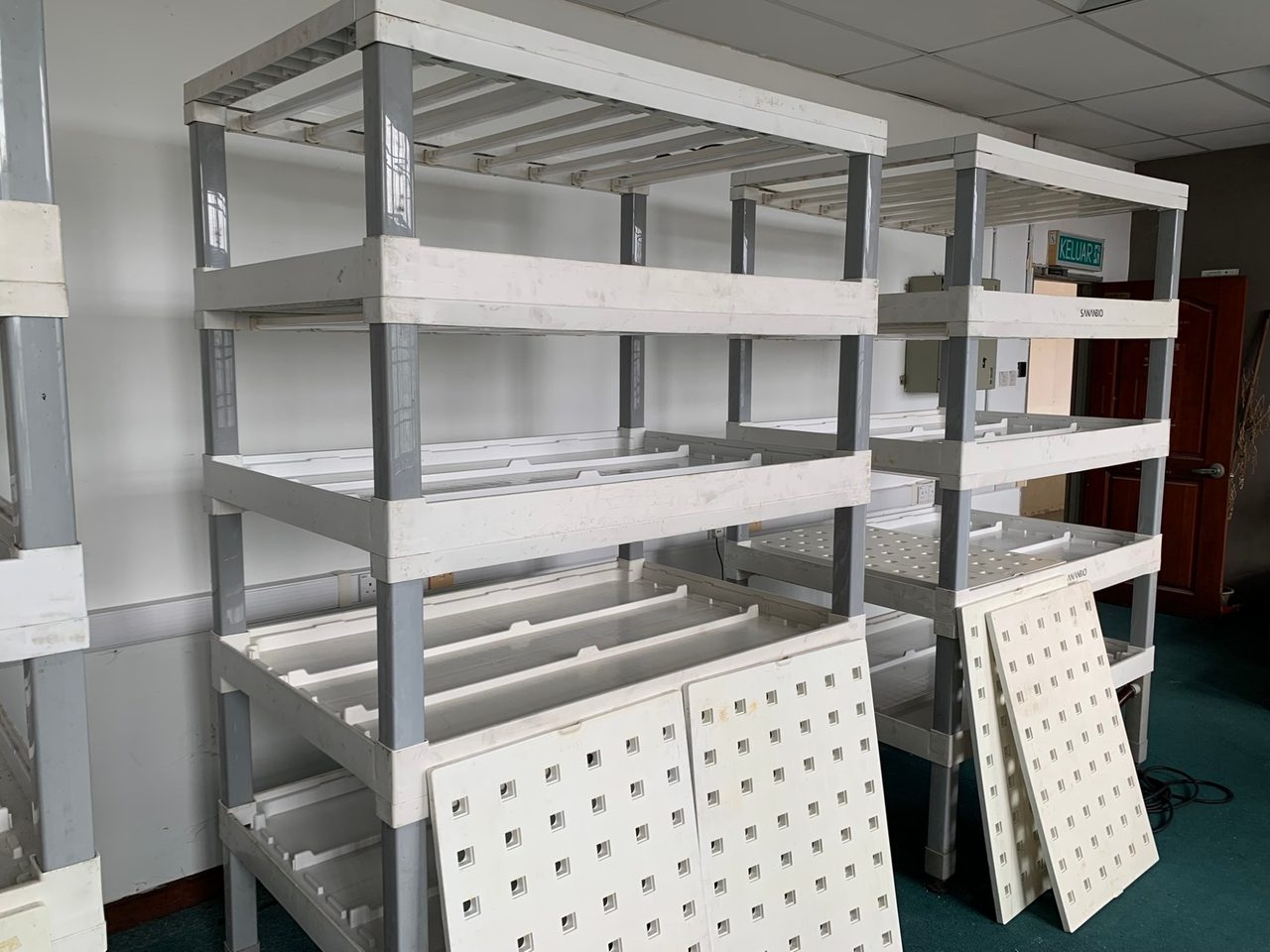
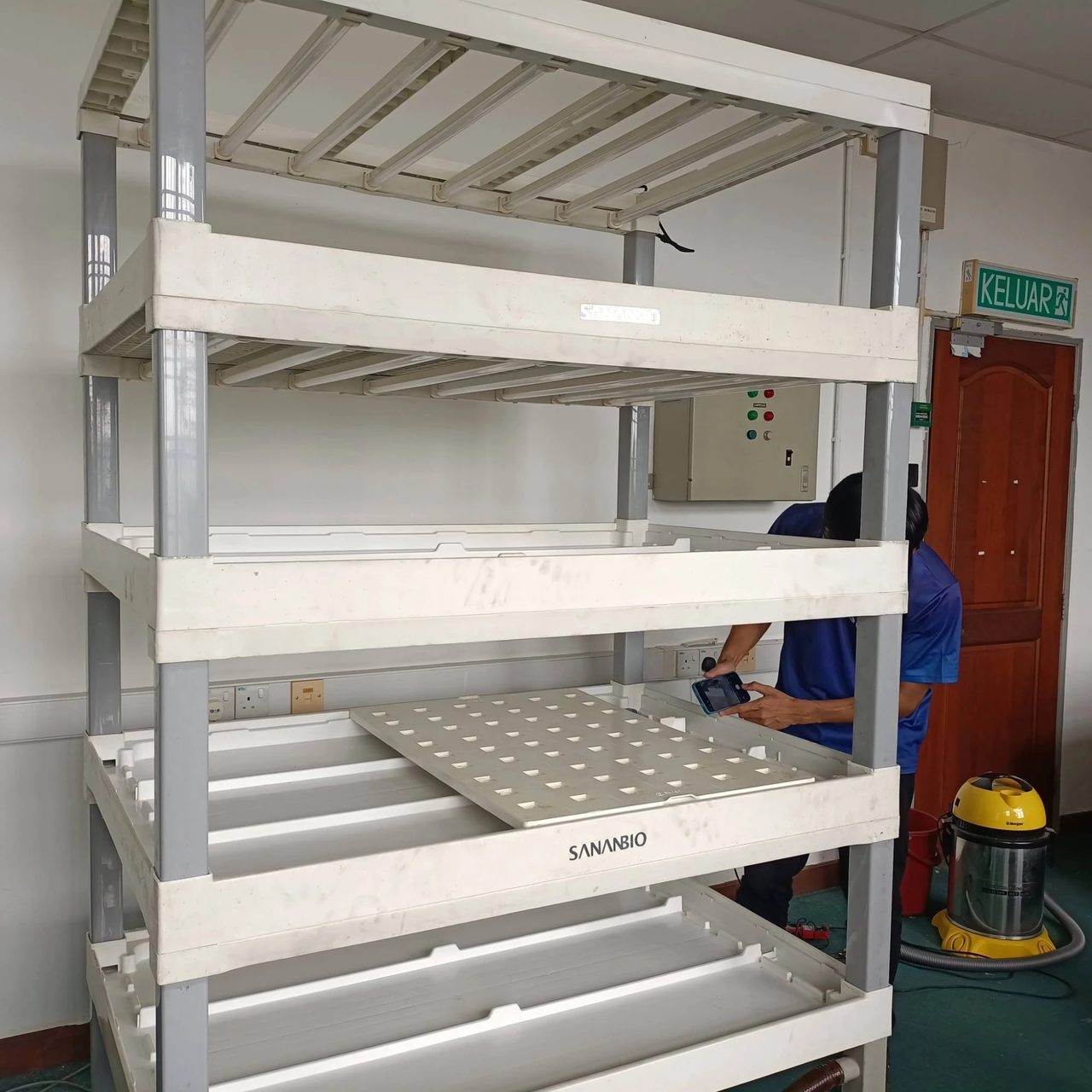
The basic system at UTM has four parts. AeroGreen Asia calls it a conventional hydroponic system, and its next step is to add sensors, IoT and AI.
Growing racks
SANANBIO racks with several levels. SANANBIO is the brand of Fujian Sananbio Technology, a vertical farming company in Xiamen, China.
Trays and plant boards
Each level holds a tray for the water. A white plant board with rows of square holes lies on the tray and holds the plants.
LED grow lights
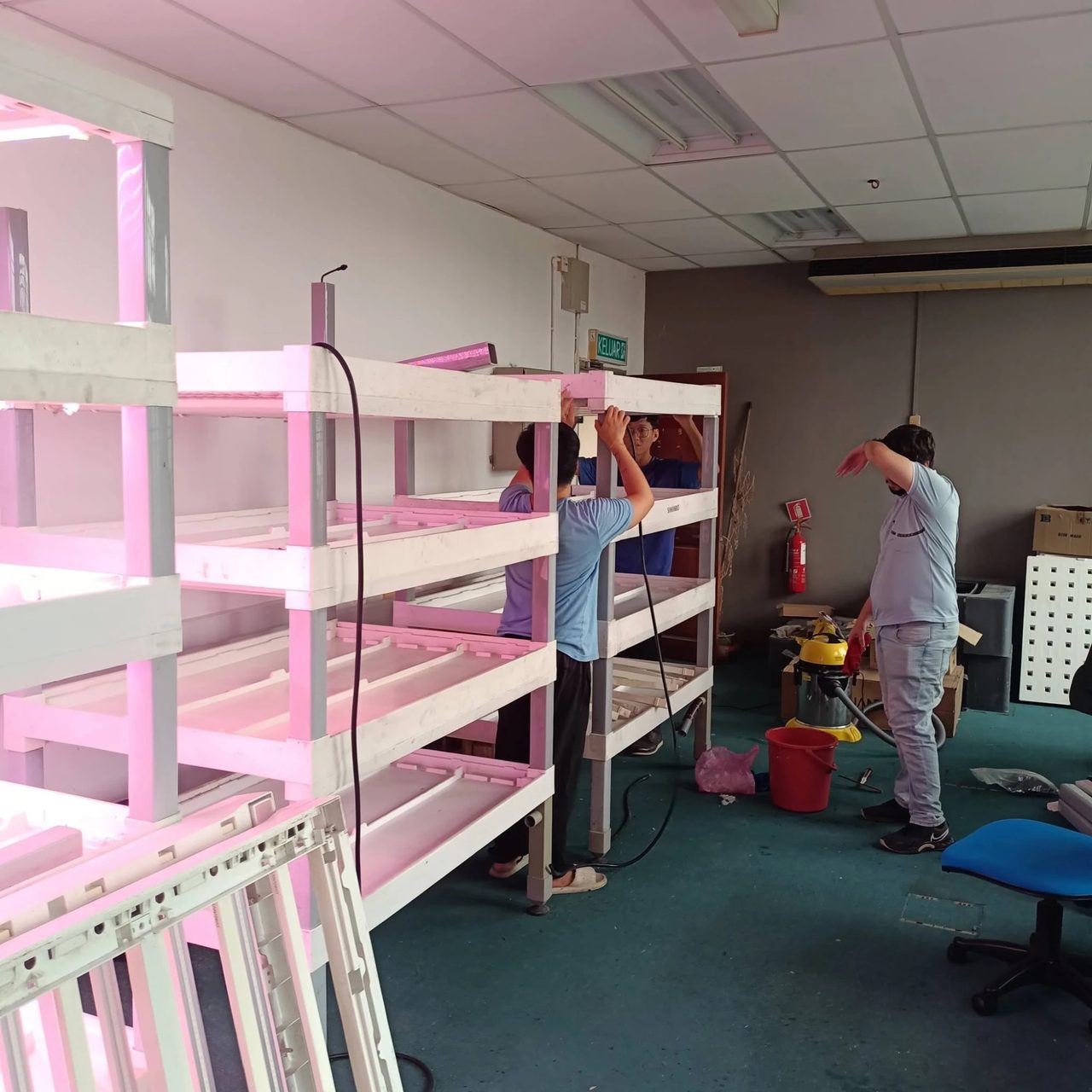
28 lights above the levels. Grow lights often mix red and blue, the colours plants use most, so the room glows pink when they are on.
Water tank
A separate grey tank stores the water for the whole system.
Who is AeroGreen Asia?
AeroGreen Asia (艾科绿) is an agriculture technology company that works on IoT and AI for farming. Its Facebook post about this project is tagged #PrecisionFarming, #SmartAgriculture, #FoodSecurity and #Sustainability. Its boss is Teo Choon Yee, who briefed the intern team together with Eric of AeroGreen Asia.
The company also works with universities. At a Southern University College webinar on 28 October 2026, the course lecturer said that AeroGreen Asia has a memorandum of understanding (MoU) with the university, and set students a real project: finding sponsors for AeroGreen Asia’s work. That talk is in our notes on personal branding.
The briefing: two projects to choose from
On Thursday 15 October 2026, from 7:30 to 9:00 pm, Teo Choon Yee and Eric met the intern team in person at Tea Garden, Sutera Utama, and presented two projects. Then they let us choose.
| Item | Option 1: IoT smart plantation | Option 2: learning platform |
|---|---|---|
| Goal | Improve the plantation with a camera that recognises the plants | Build a learning platform like Coursera |
| Starting point | All monitoring uses sensors, connected to an ESP32 board and a relay controller | The UTM learning management system (LMS) |
| Software | An Android app built in Android Studio with Kotlin | Courses on the UTM LMS |
| AI or learning path | An AI (LLM) feature in the app uses existing reliable data to automate work and help with the harvest: Google Gemma on an old PC (Core i7, 16 GB RAM, no GPU) | Learners move from theory to hands-on project practice in three levels, L1 to L3 |
I chose the IoT smart plantation. The plan was to meet later at the UTM campus laboratory to set up the configuration before development starts.
Why clean a hydroponic system before adding sensors?
Because a sensor measures whatever it sits in. Old water, dirt and algae can block the flow of water and harm new plants, and they give new sensors a false starting point. A clean, working system means the first readings describe the plants, not the leftovers. So on day one nobody touched a sensor.
“Before introducing IoT sensors and AI, we started with the basics — dismantling, thoroughly cleaning and reassembling the existing hydroponic growing system.”
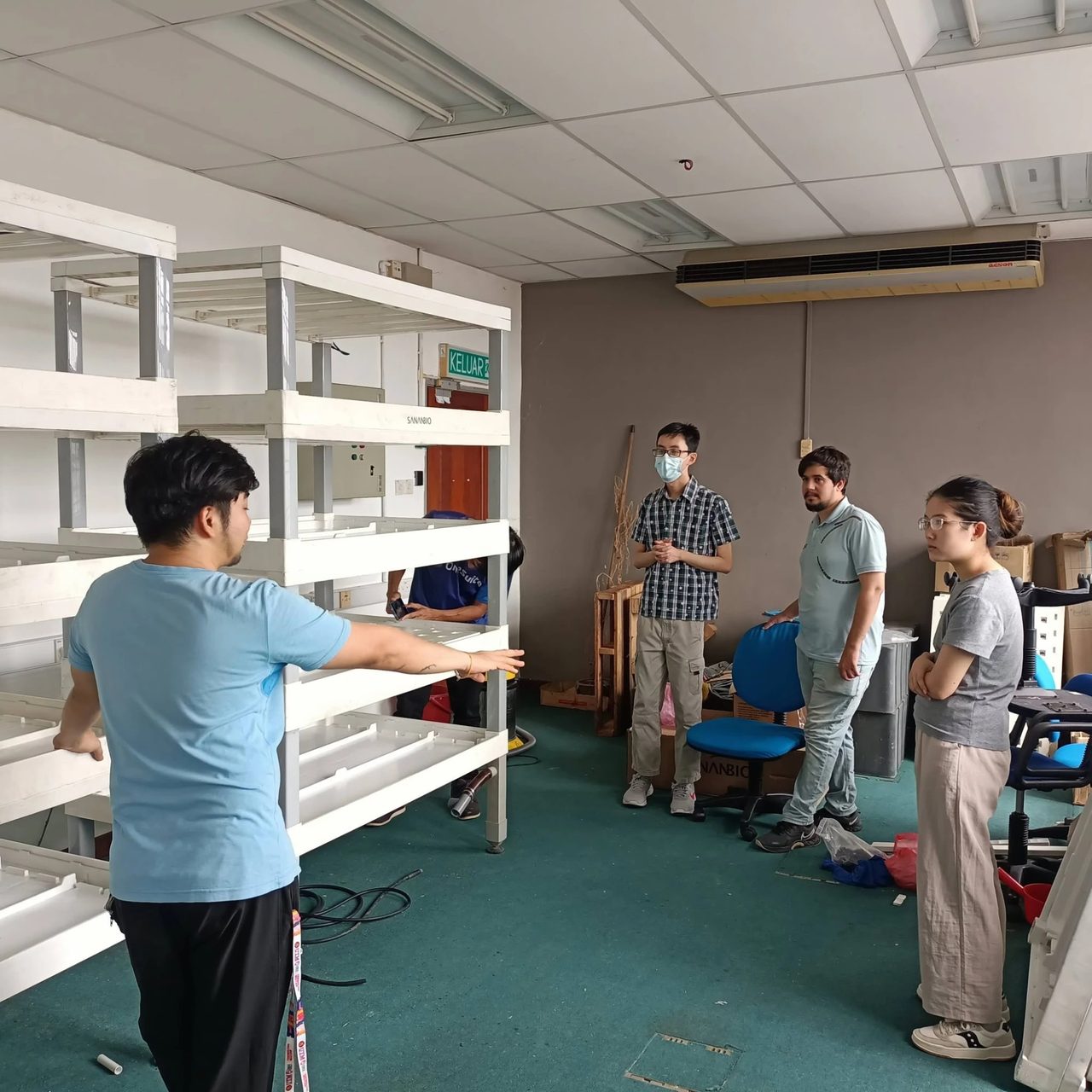
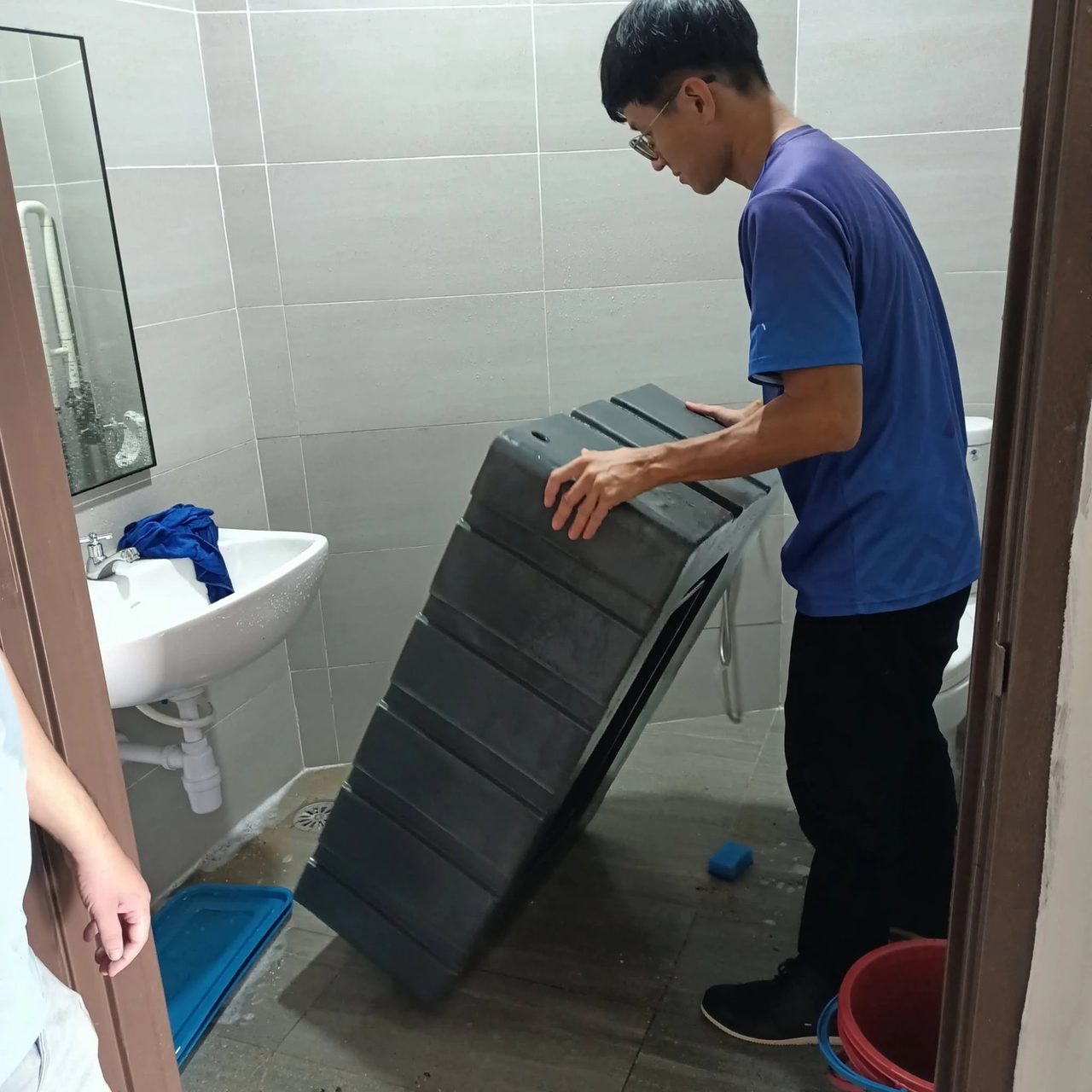
We worked at UTM on Sunday 25 October 2026, from 10:00 am to 4:00 pm, in five steps.
25 October 2026: the site day in five steps
- Briefing: the work is explained in front of the racks
- Dismantling: the growing racks are taken apart
- Cleaning: racks, trays and plant boards are cleaned, and the water tank is washed
- Reassembling: the racks go back together and the plant boards return to the trays
- Power check: the team checks the power of the 28 LED grow lights
How will sensors, an ESP32 and relays run the farm?
They form a sense–decide–act loop. Sensors measure the conditions, an ESP32 board reads them and sends the data over Wi-Fi, the Android app and the AI model work out what the plants need, and a relay, switched by the ESP32, turns pumps and lights on or off.
At the briefing, AeroGreen Asia described a smart plantation that already works this way: all monitoring uses sensors connected to an ESP32 and a relay controller, with an Android app and an AI feature on top. What the team wants to add is a camera that recognises the plants. The racks we cleaned at UTM are the conventional system that sensors, IoT and AI go on next.
The sense–decide–act loop
- Sensors measure the plants and the water
- a reading from each sensorAn ESP32 board reads the sensors
- data over Wi-FiThe Android app and the Gemma model work out what the plants need
- a signal from the ESP32A relay controller switches pumps and lights on or off
- the loop repeatsThe plants respond, and the sensors measure again
My notes from the briefing do not say which sensors the project uses. Hydroponic farms commonly measure water temperature, water level, acidity (pH) and the strength of the nutrient solution (electrical conductivity, or EC). The table below lists the parts described at the briefing.
| Part | What it does | Status at the briefing |
|---|---|---|
| Sensors | Measure the conditions of the plants and the water | In use |
| ESP32 board | Reads the sensors and sends the data over Wi-Fi | In use |
| Relay controller | Switches devices on and off on a signal from the ESP32 | In use |
| Android app | Shows the data to the user; built in Android Studio with Kotlin | In use |
| AI model: Google Gemma | Uses the existing reliable data to automate work and help with the harvest | In use, on an old PC: Core i7, 16 GB RAM, no GPU |
| Camera | Takes pictures so that the system can recognise the plants | Planned |
The app is written in Kotlin; the Android Developers site says that over 60% of professional Android developers use the language.
Can an old PC run an AI model without a GPU?
Yes, if the model is small and the job is patient. The setup described at the briefing runs Google Gemma on an old PC with a Core i7 processor, 16 GB of RAM and no graphics card (GPU). The processor does all the work, so answers come more slowly than on a GPU machine, and the 16 GB of RAM limits the size of the model. For a farm, where plants change over hours and days, I think that is enough.
What the old PC gives up
The honest trade-offs
- Speed: with no GPU, the processor does all the work, so answers come more slowly
- Model size: the whole model must fit in 16 GB of RAM, together with the operating system
- Room to grow: a larger model or heavier image work may need a stronger machine later
What the project gains
Why reuse works here
- Cost: no new hardware to buy, and no bill per token for a hosted AI service
- Reuse: a machine that had become less productive is working again
- Flexibility: an alternative that works now and can be upgraded when needed
- Less waste: one PC fewer in a storeroom or a bin
To me, the reuse is the point. Running the AI on a redundant PC is flexible, cuts the cost of the project, and puts a machine that had become less productive back to work. That is better recycling practice than leaving an old PC in a storeroom or throwing it in the bin.
The numbers behind that view are large. The United Nations’ Global E-waste Monitor 2024 counted a record 62 million tonnes of electronic waste in 2022, and less than a quarter of it (22.3%) was documented as properly collected and recycled.
- 62 MtE-waste produced in 2022A record, up 82% from 2010
- 22.3%Documented as properly collected and recycledLess than a quarter of that mass
- 82 MtProjected for 2030With the recycling rate falling to 20%


How much electricity do 28 grow lights use?
Each LED grow light at UTM uses about 80 W (0.08 kW). With all 28 on, they draw 28 × 0.08 = 2.24 kW. Energy is power multiplied by time, so if the lights run 12 hours a day, for example, they use 2.24 × 12 = 26.88 kWh a day, or about 806 kWh in a 30-day month. My first note rounded the load to 2; the exact figure is 2.24.
- 80 WOne grow lightAbout 0.08 kW, from the team’s check
- 2.24 kWAll 28 lights on28 × 0.08 kW
- 26.88 kWhA 12-hour day2.24 kW × 12 hours
- 806 kWhA 30-day month26.88 kWh × 30, at 12 hours every day
The two numbers answer different questions. The power (2.24 kW) tells you whether the electrical supply can carry the load; the team judged this load acceptable. The energy (kWh) tells you what the lights will cost to run: multiply it by your electricity tariff.
Why do smart farms matter for Malaysia?
Malaysia grows less than half of the vegetables it eats. In 2023 its self-sufficiency in vegetables was about 45.4%, according to the Agriculture Ministry figure reported by CodeBlue, although it reached 83.1% for tropical vegetables. Indoor, measured farming such as hydroponics can grow food in less space, close to the people who eat it.
AeroGreen Asia’s own post frames the UTM work the same way: a step towards smarter and more sustainable food production.
What comes next
Next is the configuration at the UTM campus laboratory, then sensors, IoT and AI on the cleaned system, and later the camera that recognises the plants.
- 15 October 2026
Briefing and choice
Two options presented at Tea Garden, Sutera Utama. I chose the IoT smart plantation.
- 25 October 2026
Site day at UTM
Racks dismantled, cleaned and reassembled; water tank washed; power of the 28 grow lights checked.
- Next
Configuration at the UTM campus laboratory
The setup work before development starts.
- Then
Sensors, IoT and AI on the cleaned system
In AeroGreen Asia’s words, turning a conventional hydroponic into a platform for smarter crop management.
- Later
A camera that recognises the plants
The enhancement described at the briefing: plant recognition on top of the sensor data.
What I learned on day one
- A smart farm starts with a clean, working basic system; sensors and AI come after.
- A simple number should be calculated exactly: 28 × 0.08 kW is 2.24 kW, not 2.
- An AI model does not always need an expensive GPU. Reusing an old PC saves money and keeps a working machine out of the waste stream.
Common questions
What is a smart hydroponic system?
A soil-free growing system with sensors, a controller and software added. Sensors measure the water and plants, a board such as an ESP32 reads them and sends the data on, an app or AI model decides what to do, and relays switch pumps and lights. The system adjusts itself instead of waiting for a person to check it.
What does an ESP32 do in a hydroponic farm?
It reads the sensors and sends their data over Wi-Fi, and it can switch a relay that turns a pump or a light on or off. It is a small, cheap microcontroller with built-in Wi-Fi and Bluetooth, which is why it is common in IoT projects.
Can you run an AI model on an old PC without a GPU?
Yes, if the model is small. In the setup described at the briefing, Google Gemma runs on an old Core i7 PC with 16 GB of RAM and no GPU. The processor does all the work, so answers are slower and the RAM limits the model size. For a farm, where plants change over hours, that is enough, and the old PC is reused instead of thrown away.
How much electricity do LED grow lights use?
Multiply the power of one light by the number of lights, then by the hours. At UTM, 28 lights of about 80 W each draw 2.24 kW together, which is 26.88 kWh in a 12-hour day, or about 806 kWh in a 30-day month.
Why clean a hydroponic system before adding sensors?
Old water, dirt and algae can block the water flow and harm new plants, and they give new sensors a false starting point. A clean, working basic system gives the sensors and the AI a true baseline.
Who is AeroGreen Asia?
AeroGreen Asia (艾科绿) is an agriculture technology company working on IoT and AI for farming. Its boss is Teo Choon Yee. It runs a smart hydroponics project at Universiti Teknologi Malaysia with an intern team and, according to a Southern University College lecturer, has an MoU with that university.
Sources
- Precision Farming Starts with Getting Our Hands Dirty! — AeroGreen Asia on Facebook, 25 October 2026
- Fujian Sananbio Technology Co., Ltd (maker of the SANANBIO racks) — GreenTech
- ESP32 Wi-Fi & Bluetooth SoC — Espressif Systems
- Gemma models overview — Google AI for Developers
- Kotlin and Android — Android Developers
- Global E-waste Monitor 2024: electronic waste rising five times faster than documented recycling — UNITAR, 20 March 2024
- Malaysia records 45% vegetable self-sufficiency, tropical veggies at 83% SSR — CodeBlue, August 2025